
Boost Your
Shopify Store's Recurring Revenue With Utterbond!

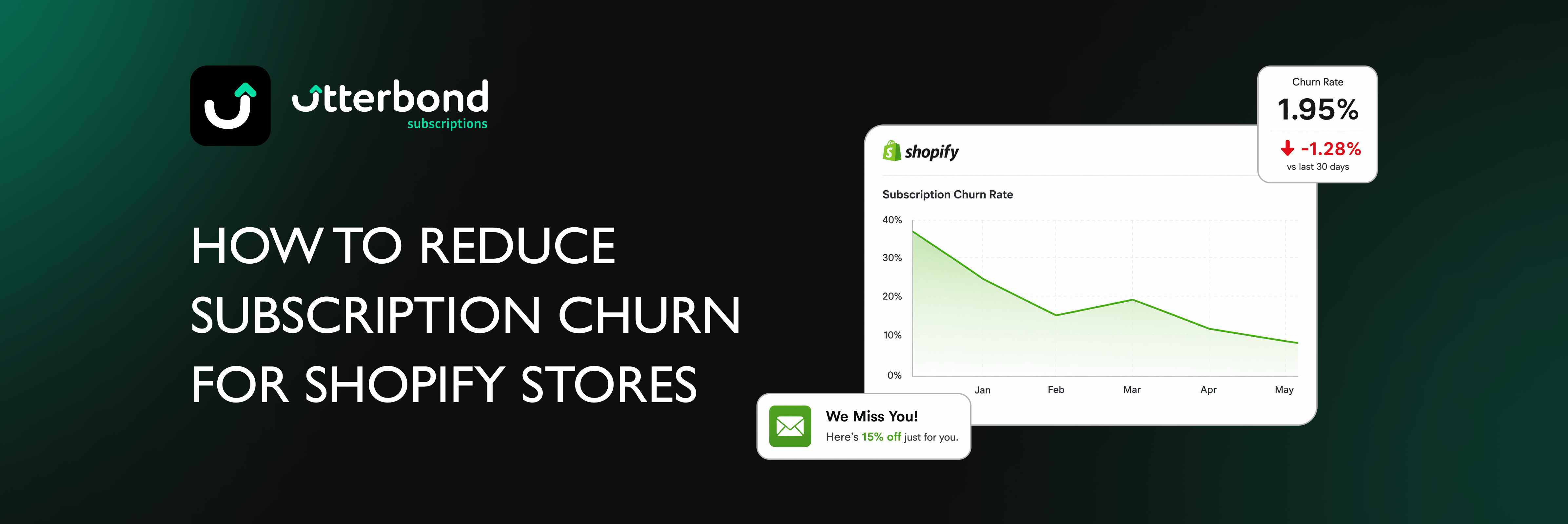
Shopify subscription churn quietly destroys recurring revenue: and most store owners don't notice until the damage is already done. There's no dramatic moment, no spike in returns. Subscribers just disappear one by one, and the compounding loss adds up fast.
The good news: you can reduce subscription churn with a handful of targeted fixes that don't require a complete overhaul. Most of the causes are predictable, and most of the solutions are already within reach. Knowing how to reduce subscription churn is the difference between a store that scales and one that's constantly refilling a leaky bucket.
This guide walks you through 8 proven strategies covering both voluntary and involuntary shopify subscription churn, plus a dedicated section on recovering failed payments, and a quick-action checklist you can start working through today.
What Is Subscription Churn (and Why It Hurts More Than You Think)
Subscription churn is the percentage of subscribers who stop their subscription in a given period: and even a modest monthly rate compounds into a massive annual loss.
Churn comes in two flavours, and they need completely different fixes.
📖 Churn Rate: the percentage of subscribers who cancel (or lapse) in a given time period. Formula: (Cancelled subscribers ÷ Total subscribers at start of period) × 100. A 5% monthly churn rate means you lose ~46% of your subscriber base over 12 months, even if you're adding new subscribers the whole time.
📖 Voluntary Churn: when a customer actively decides to cancel their subscription. They log in, hit cancel, and they're gone. Driven by boredom, price sensitivity, or the product no longer fitting their life.
📖 Involuntary Churn: when a subscription lapses because a payment fails (expired card, insufficient funds, bank decline), not because the customer chose to leave. The customer often doesn't even know it happened.
Voluntary churn is when a customer actively decides to cancel. They log in, hit the cancel button, and they're done. This is driven by things like boredom, price sensitivity, or feeling like the product no longer fits their life.
Involuntary churn is sneakier. It happens when a payment fails: expired card, insufficient funds, bank decline: and the subscription quietly lapses. The customer didn't decide to leave. They just... disappeared. According to Recurly's 2024 benchmark study of 1,200+ subscription businesses, involuntary churn accounts for 20–40% of all subscription cancellations. That's a huge chunk of your lost subscribers who never actually wanted to go.
So if you started the month with 500 subscribers and 25 cancelled, your monthly churn rate is 5%. Sounds manageable. But run that for 12 months and you've lost ~46% of your original base: even if you're constantly adding new subscribers. The compounding effect is brutal.
According to Recurly's benchmark data across 1,200+ subscription sites, the median overall monthly churn rate sits at 3.27%, with consumer goods and retail running closer to 6.5%. If you're a Shopify subscription store selling physical products, that 6.5% benchmark is your real reference point: not the SaaS averages you'll see quoted everywhere.
Key takeaway: Shopify subscription churn has two distinct causes: voluntary cancellations and failed payments: and each needs its own fix.
Common Reasons Shopify Subscribers Cancel
Most cancellations trace back to five predictable problems. Identify which ones are hitting your store hardest, and you've already got your retention roadmap.
Most cancellations come down to a handful of predictable problems. Fix these, and you've already won most of the battle.
They forgot why they signed up (value not reinforced)
Subscribers sign up excited. Then life happens, the product becomes background noise, and they start questioning whether it's worth it. If you're not regularly reminding them of the value they're getting: through emails, unboxing moments, or usage tips: they'll quietly talk themselves out of it.
The product no longer fits their needs (no flexibility)
A customer's situation changes. They travel for a month. They already have six months of product stocked up. They want a different flavour. If the only options are "keep it exactly as is" or "cancel", most people will cancel. Flexibility is retention.
Payment failed and no one followed up (involuntary churn)
This is the most fixable churn of all, and yet it's the most ignored. A card expires, the charge fails, and the subscription lapses. The customer gets no warning, no recovery email, nothing. They didn't choose to leave: your process just let them slip away. According to Recurly's 2025 press release, failed payments could cost subscription companies more than $129 billion globally in 2025.
The checkout or management experience was frustrating
A confusing sign-up flow kills conversions before they even start. And a customer portal that requires emailing support just to skip a delivery? That frustration turns into a cancellation. Friction at any point in the subscription lifecycle costs you subscribers.
They found a better deal elsewhere
Price and perceived value are always in play. If a competitor offers a similar product with more flexibility or a lower price, and you haven't given your subscribers a reason to stay loyal, they'll switch. Loyalty programs and subscriber-exclusive perks directly address this.
Key takeaway: Cancellations are almost always predictable: failed payments, lack of flexibility, and forgotten value are the top three culprits.
8 Proven Strategies to Reduce Subscription Churn for Shopify Stores
Here are the 8 strategies that move the needle most on subscription churn for Shopify stores: from quick wins like pause options to longer-term plays like cohort analysis. A clear subscription churn strategy is what separates stores that hit 2% monthly churn from those stuck at 6%+.
Before diving in, here's a quick overview of all 8 strategies so you can prioritize:
Every one of these tactics is designed to reduce subscription churn for Shopify stores in a specific, measurable way. Pick your highest-pain area and start there.
1. Make Cancellation Hard (But Not Annoying)
Don't make it impossible to cancel: that just creates angry customers and chargebacks. But do add a cancellation flow that presents alternatives before the final cancel button.
When someone clicks "cancel", show them options: pause for 30 days, skip the next delivery, swap to a different product. A lot of people who click cancel aren't 100% sure they want to leave. They're frustrated, or they need a break. Give them an exit ramp that isn't the door.
Utterbond's customer portal includes a built-in cancellation flow where subscribers can pause, skip, or swap products before confirming cancellation. That one feature alone captures a meaningful slice of would-be churners.
2. Fix Involuntary Churn with Smart Dunning Management
Smart dunning is the single highest-ROI fix for most Shopify subscription stores: it recovers revenue that's already been earned, from customers who didn't even want to leave.
Smart dunning means:
- Retrying the charge on different days (not just immediately after failure)
- Sending a pre-failure warning when a card is about to expire
- Sending a post-failure recovery email with a direct link to update payment details
- Escalating reminders if the first email doesn't get a response
Utterbond has built-in dunning management that handles retries and automated email notifications automatically: and it's one of the fastest ways to reduce subscription churn without touching your product or pricing. For more on setting up smart dunning on Shopify, the setup process is straightforward once your subscription app is connected.
According to Baremetrics' dunning management analysis, intelligent retry logic alone recovers 40–60% of failed payments, rising to 75–85% by day 30 when combined with email sequences. That's not a marginal improvement: that's potentially recovering thousands in monthly recurring revenue you're currently leaving on the table.
3. Let Customers Customize Their Subscription (Product Swap & Build-a-Box)
Giving subscribers control over what they receive is one of the most underrated retention tools: it turns a passive subscription into an active, invested one.
Boredom is a churn driver that's easy to underestimate. A subscriber who's been getting the same product for six months might not hate it: they're just tired of it. If they can't change anything without cancelling and restarting, they'll cancel.
Product swap lets subscribers change what they receive without touching their subscription. Same billing cycle, different item. It's a small feature with a big retention impact.
Build-a-box goes further: it lets customers curate their own subscription box from a selection of products. When someone has built their own box, they're invested in it. The perceived value is dramatically higher than a pre-set bundle.
Utterbond supports both product swap and build-a-box subscription bundles natively, without needing a separate app or custom development.
4. Offer Pause and Skip Options
Pause and skip are the simplest retention features to add: and they consistently save subscribers who just need a break, not an exit.
Many subscribers cancel because they need a break: they're going on holiday, they've overstocked, they're tight on cash this month. They don't hate your product. They just need a few weeks off.
If the only option is "cancel", they cancel. If you offer "pause for 4 weeks", a significant portion will pause instead.
Recurly's 2024 retention data found that pauses grew 66% year-over-year, with one case study showing Userlike retained 20% of at-risk subscribers using the pause feature alone. Chargebee's survey data found that 58% of consumers have paused a subscription instead of cancelling in the past year.
Utterbond's portal includes both pause and skip natively. Subscribers can manage this themselves without contacting support.
5. Use Automated Email Notifications to Stay Connected
Automated, event-triggered emails are the lowest-effort way to keep subscribers engaged: and they directly reduce both voluntary and involuntary churn.
Subscribers who feel forgotten cancel faster. If the only time you email them is when there's a problem, you're not building a relationship: you're just sending bad news.
Set up triggered emails for every key subscription event:
- Upcoming renewal reminder (3–5 days before billing)
- Order shipped confirmation
- Payment failed recovery email
- Subscription paused confirmation
- Welcome / onboarding sequence after sign-up
Utterbond sends automated email notifications based on subscription events, so these go out without any manual work on your end. For a broader look at email and SMS marketing for subscriptions, personalizing subject lines with the subscriber's name and product makes a real difference to open rates.
The renewal reminder email is one of the highest-leverage touchpoints you have. It reminds subscribers what they're getting, reduces payment surprise, and gives you a chance to highlight value before the charge hits.
6. Reduce Friction at Checkout and in the Customer Portal
Friction at sign-up and in the customer portal are two of the most common: and most preventable: causes of subscription churn.
Two friction points kill subscriptions: the sign-up and the self-management experience.
A complicated checkout loses potential subscribers before they ever commit. One-click checkout dramatically reduces drop-off at the sign-up stage: fewer steps, fewer second thoughts, more completed subscriptions. Read more about one-click checkout for subscriptions and how it changes the conversion picture.
A frustrating customer portal is just as damaging. If a subscriber has to email your support team just to skip a delivery or update their address, they'll get annoyed: and annoyed subscribers cancel. A self-serve portal where subscribers can manage everything themselves removes that friction entirely.
Utterbond provides a branded, self-serve customer portal that handles pause, skip, swap, address changes, and payment updates without any support involvement.
7. Reward Loyal Subscribers (Perks, Discounts, Exclusive Access)
Loyalty rewards give long-term subscribers a concrete reason to stay: and they're especially effective at preventing churn at the 3-month and 6-month marks.
Loyalty isn't automatic. You have to build it deliberately, and the best way to do that is by making long-term subscribers feel like they're getting something extra.
Some ideas that work well:
- Subscriber-only discount (e.g., 10% off their 3rd month renewal)
- Free gift at the 6-month milestone
- Early access to new products before they go public
- Exclusive bundles only available to active subscribers
Gift subscriptions for Shopify stores are also worth considering here. Customers who receive a gift subscription are already "warmed up": they came in with a positive association, which tends to translate into lower early churn.
8. Track Churn by Cohort and Act on the Data
Cohort analysis tells you exactly when subscribers are most likely to leave: which is the only way to build interventions that actually land at the right moment.
Overall churn rate is a lagging indicator. By the time it moves, you've already lost subscribers. Cohort analysis tells you when subscribers are most likely to cancel: and that's where the real insight lives.
A cohort is just a group of subscribers who joined in the same period (e.g., everyone who signed up in January). Tracking cohorts separately reveals patterns:
- If most churn happens in month 1, your onboarding is broken. Subscribers aren't getting value fast enough.
- If most churn happens in month 3, your value proposition needs reinforcing. The initial excitement has worn off.
- If churn spikes in month 6, check whether a loyalty perk or milestone reward at that point would help.
Utterbond integrates with GA4 for analytics tracking, giving you the data layer you need to run this kind of analysis. Pair that with your subscription app's dashboard and you've got a clear picture of where to intervene.
Key takeaway: These 8 strategies work best in combination: start with dunning and pause options (lowest effort, highest impact), then layer in cohort tracking and loyalty rewards.
Involuntary Churn Deserves Its Own Strategy
Involuntary churn: subscriptions that lapse due to failed payments, not customer decisions: is responsible for 20–40% of all cancellations, and it's almost entirely fixable.
Most Shopify store owners focus all their retention energy on voluntary churn: the customers who actively decide to leave. That's understandable. But involuntary churn is often just as large and far easier to fix.
Failed payments are silent. The customer didn't decide to leave. Their card expired, or their bank flagged the transaction, and the subscription just... stopped. They might not even know it happened until they notice they stopped receiving deliveries.
According to Recurly's 2025 press release, failed payments are projected to cost subscription companies more than $129 billion globally in 2025. For context: industry data consistently shows that 10–14% of card payments fail globally: which means a meaningful slice of your billing attempts will fail every single month without a recovery system in place.
A proper subscription churn strategy to reduce shopify subscription churn from failed payments looks like this:
- 7–10 days before card expiry: send a "your card is about to expire" email with a direct link to update payment details
- On payment failure: retry automatically, then send a recovery email within 24 hours
- If the first retry fails: retry on a different day (mid-week tends to perform better), send a second email
- Final notice: one last email before the subscription lapses, with a clear CTA to update billing
Utterbond's dunning management handles this automatically. You set the rules, and the system does the follow-up.
The payoff is significant. Baremetrics' dunning data shows that hybrid dunning approaches (smart retries + email sequences) can achieve 80–90% payment recovery within 30 days. For a Shopify store doing $10,000/month in subscription revenue, that's potentially $1,000–$2,000/month recovered from a process that runs on autopilot: without acquiring a single new subscriber. That's what it means to decrease subscription churn for Shopify at the infrastructure level.
Key takeaway: Involuntary churn is the most underrated revenue leak in subscription e-commerce: and smart dunning is the fix that pays for itself fastest.
How Utterbond Helps You Decrease Subscription Churn for Shopify
Utterbond is a Shopify subscription app built to address every major driver of subscription churn: from failed payments to boredom-driven cancellations.
Utterbond is a Shopify subscription app built specifically to reduce subscription churn for Shopify stores at every stage of the subscriber lifecycle. If you want to decrease subscription churn and keep your MRR growing, here's what's directly relevant to retention:
- Customer portal: self-serve, branded, with pause, skip, swap, and cancellation flow built in
- Dunning management: automated payment retries and email notifications for failed payments
- Automated email notifications: triggered by subscription events (renewal, shipment, failure, pause)
- Build-a-box bundles: lets subscribers curate their own box, increasing perceived value and reducing boredom-driven churn
- Product swap: subscribers can change items without cancelling
- Prepaid subscriptions: collect payment upfront, reducing involuntary churn exposure
- Integrations: Klaviyo, Omnisend, Gorgias, GA4, Rivo, Marsello, ReferralCandy
Pricing starts free (with a 2% transaction fee), and paid plans start from $19/month with 0% transaction fees: making it accessible for stores at every stage.
You can check out the full feature set on the Utterbond Shopify app listing, or compare it against the best Shopify subscription apps to see how it stacks up.
Key takeaway: Utterbond covers every major shopify subscription churn driver in one app: dunning, pause/skip, product swap, build-a-box, and automated emails: starting free.
Quick Churn Reduction Checklist
Use this checklist as your starting point to reduce subscription churn for Shopify stores. Each item maps directly to a specific churn driver: work through it in order of impact.
- Set up smart dunning (automated payment retries + email alerts)
- Add pause and skip options to your customer portal
- Enable product swap so subscribers can change items without cancelling
- Send automated renewal reminder emails 3–5 days before billing
- Add a cancellation flow with a "pause instead" offer before the final cancel button
- Offer a loyalty perk at the 3-month and 6-month mark
- Review cohort churn data monthly: find the drop-off point and address it
- Test one-click checkout to reduce sign-up friction
Key takeaway: If you only do three things from this list to reduce subscription churn, make them: dunning setup, pause/skip options, and a cancellation flow with alternatives.
FAQ
Q: What is the average subscription churn rate for Shopify stores?
For Shopify subscription stores selling physical products, the average monthly churn rate is around 6.5%, based on Recurly's benchmark data across 1,200+ subscription businesses. The median across all subscription types is 3.27% monthly. Top-performing Shopify subscription stores typically achieve 2–3% monthly churn. Knowing how to reduce subscription churn is what gets you from 6.5% down to that 2–3% range: it's not luck, it's process.
Q: What is a good subscription churn rate for Shopify stores?
For e-commerce subscriptions, a monthly churn rate below 5% is generally considered healthy. The best-performing Shopify subscription stores aim for 2–3% monthly churn or lower. Consumer goods and retail subscriptions average around 6.5% monthly according to Recurly's benchmark data, so if you're in that range, you're at the industry average: but there's real room to improve.
Q: What's the difference between voluntary and involuntary churn?
Voluntary churn is when a customer actively decides to cancel their subscription. Involuntary churn happens when a payment fails and the subscription lapses without the customer intending to leave. Both need separate strategies: voluntary churn requires retention tactics and flexibility (pause, swap, loyalty perks), while involuntary churn requires dunning management and automated payment recovery. A solid subscription churn strategy addresses both simultaneously. According to Recurly's 2024 data, involuntary churn makes up 20–40% of all subscription cancellations.
Q: How does dunning management reduce subscription churn?
Dunning management automatically retries failed payments and sends reminder emails to customers, recovering subscriptions that would otherwise silently lapse. It's one of the most direct ways to reduce subscription churn without changing your product or pricing at all. According to Baremetrics' dunning analysis, intelligent retry logic recovers 40–60% of failed payments initially, rising to 75–85% by day 30 when combined with email sequences. Apps like Utterbond have this built in, so it runs without any manual intervention on your end.
Q: Can offering a pause option really reduce cancellations?
Yes: and the data backs it up. Recurly's 2024 retention report found that pauses grew 66% year-over-year, with one case study showing Userlike retained 20% of at-risk subscribers using pause alone. Chargebee's research found that 58% of consumers have paused a subscription instead of cancelling. Many subscribers cancel because they need a temporary break, not because they dislike the product. A pause option captures those moments.
Q: How do I track subscription churn on Shopify?
Use your subscription app's analytics dashboard combined with GA4 (which Utterbond integrates with natively). The key is to track churn by cohort: group subscribers by when they joined and watch when each group drops off. That tells you the exact month where most cancellations happen, so you can build targeted interventions at that point. Monthly cohort reviews are the minimum; weekly is better if your subscriber base is large enough.
Q: Does Utterbond help reduce Shopify subscription churn?
Yes: Utterbond is built to reduce shopify subscription churn across every touchpoint. It includes built-in dunning management, a self-serve customer portal with pause/skip/swap, automated email notifications, build-a-box bundles, and product swap. These features directly address both voluntary and involuntary churn. If you want to decrease subscription churn for Shopify without stitching together five different apps, Utterbond handles it in one place. Pricing starts free (with a 2% transaction fee), with paid plans from $19/month at 0% transaction fees.
Q: How long does it take to see results after implementing churn reduction strategies?
Dunning and pause/skip options show results within the first billing cycle: typically 30 days. Loyalty rewards and cohort-based interventions take 60–90 days to show meaningful impact, since you need enough data to spot patterns. According to industry benchmarks, stores that implement a full subscription churn strategy (dunning + flexibility options + loyalty) typically see monthly churn drop by 1–3 percentage points within 90 days: which compounds significantly over a year. That's what it looks like to systematically reduce subscription churn for Shopify stores over time.
Useful Sources
- Recurly Churn Rate Benchmarks: industry benchmark data across 1,200+ subscription businesses
- Recurly: Failed Payments Could Cost Subscription Companies $129B in 2025: press release with global involuntary churn projections
- Stripe: Subscription Churn 101: clear breakdown of churn types and payment failure causes
- Chargebee: The Power of Pause in Subscription Retention: data on pause options and their effect on cancellations
- Baremetrics: Dunning Management Guide: practical breakdown of dunning strategies and recovery rates
- Recurly: Why Pausing a Subscription Can Be a Powerful Retention Tactic: 2024 pause growth data and case studies
Boost Recurring Revenue with Shopify Subscriptions
Enhance your customers' lifetime value by introducing subscription options. Start now with the free Shopify Subscriptions app and build lasting relationships while securing a steady revenue stream.
Learn more
.svg)
.webp)

